01 · Overview
At Scribe, I led design and research on a digital adoption platform built from Scribe itself. People would record and edit Scribes as usual, then pin tooltips and whole walkthroughs inside the software their company already ran. Platforms like that are bought from the top down. We wanted this one to spread from the bottom up, one team at a time, until the company realized it needed the full suite.
- Role
- Senior Product Designer at Scribe, leading design and research for Layers
- When
- Sep 2024 – Feb 2025
- Product
- Scribe Layers, a new product on Scribe's Chrome extension and web app
- Team
- Me, a product manager and three engineers from the extension team
- Method
- Interviews and a question diary, then a working prototype and a six-week pilot
- Outcome
- Six pilot companies. Four asked about buying before the pilot ended.
Fieldstone Logistics, Halden and the names of everyone in this story have been changed for client confidentiality.
02 · The short version
Problem. Companies buy adoption platforms for IT, and employees learn to close the tours. The help people actually use is a coworker answering the same questions in chat all week.
What I did. Led the research with go-to people and IT owners, then designed Layers end to end, from authoring on a live page to the admin view that turns team use into a purchase.
The result. A six-week pilot with six companies. Repeat questions to go-to people fell 58%, and four of the six asked about buying before it ended.
ResearchProduct strategyInteraction designAI draftingBrowser extensionAdmin and governanceDesign system
03 · Context
A digital adoption platform puts help inside software a company already runs: a tooltip on a field, a tour through a form. WalkMe is the best known, and the buyer is almost always IT.
The official help
IT signs a three-year contract and a small team writes the tours. They go out to everyone at once, and in the accounts we studied, 7 in 10 were closed at the first step.
The real help desk
The questions go to a person instead. Every team has one, like Priya in procurement, who hears the same few all week. The one Priya hears most is which general ledger (GL) account a purchase goes to.
The cost
In Scribe's own brand research, 98% of its power users described themselves as that go-to person. They lose about 12 hours a week to questions they've already answered.
04 · Research
Follow the questions to the person who answers them
Scribe's usage already pointed at this person: in most companies a handful of people made most of the Scribes, and everyone around them opened the links. I went looking for them, and for the IT owners who would one day have to approve whatever we built.
18 interviews. Ops leads and finance admins, the people their teams message first, at companies from 300 to 9,000 employees.
A two-week diary. Nine of them logged every question they got, with who asked and what the asker had open.
11 IT and app owners. The people who sign for adoption platforms, on why they bought one and when they turned it off.
Scribe's own usage. Which Scribes get opened again and again, and which app sits in the next tab when they are.
Four platforms, taken apart. WalkMe, Whatfix, Pendo and Userlane, compared on who writes the help and what happens to it when the app changes.
Lost deals. Sales calls where Scribe lost an enterprise deal to an adoption platform. The buyer was IT every time.
The question diary
Nine go-to people logged every question they got for two weeks: 1,312 of them, one tick each.
Repeats
64% repeated an earlier question, often from the same person and often word for word.
Mid-task
71% came from someone with the app open, partway through the task they were asking about.
One field
82% were about a single field. The answer belonged beside that field, at the moment someone reached it.
05 · Findings
Every team already had a help desk. It was one person.
The diary showed the shape of the work, and the interviews explained it. What the go-to people wanted most was to stop typing the same answer.
Finding 1They were already writing the docs, in chat. 61% of diary answers were a screenshot or a Scribe link, sent again to each person who asked.
Design response The Scribe they already record goes live on the page, right where the question comes up.
Finding 2Questions are about one field. 82% of logged questions named a single field, and 71% arrived mid-task.
Design response A layer attaches to one element and appears when someone reaches it.
Finding 3Help that breaks once stops being trusted. 4 of the 11 IT owners had switched a platform off after an app update broke its tours.
Design response Layers find their field again after an update, and ask the author when they aren't sure.
Finding 4IT buys what is already working. 8 of 11 IT owners said their last software purchase started with a team that was already using it.
Design response IT gets a view of who uses what, so buying is a decision about something already running.
“I keep the answers in a sticky note so I can paste them faster.”
06 · The reframe
A classic adoption platform starts with a contract and works its way down to people.
Layers starts with one person, the one who already answers the questions.
Their answers go where people get stuck, and teammates find them there.
It spreads team by team. By the time IT looks, 212 people already depend on it.
07 · Capture goes live
Priya records a capital requisition in Halden, the way anyone records a Scribe.
Steps
Each click becomes a step with a screenshot, and the notes typed along the way become the step's text.
One new switch
The end of the capture has one extra setting: make it live on Halden.
Live
The clicks become anchors. A walkthrough, a hint and a checklist land on the page, where the team will run into them.
Layers starts where Scribe already worked: the capture I had reworked earlier across web, Windows and Mac.
08 · Layer Studio
Edit on the live page, starting from a draft
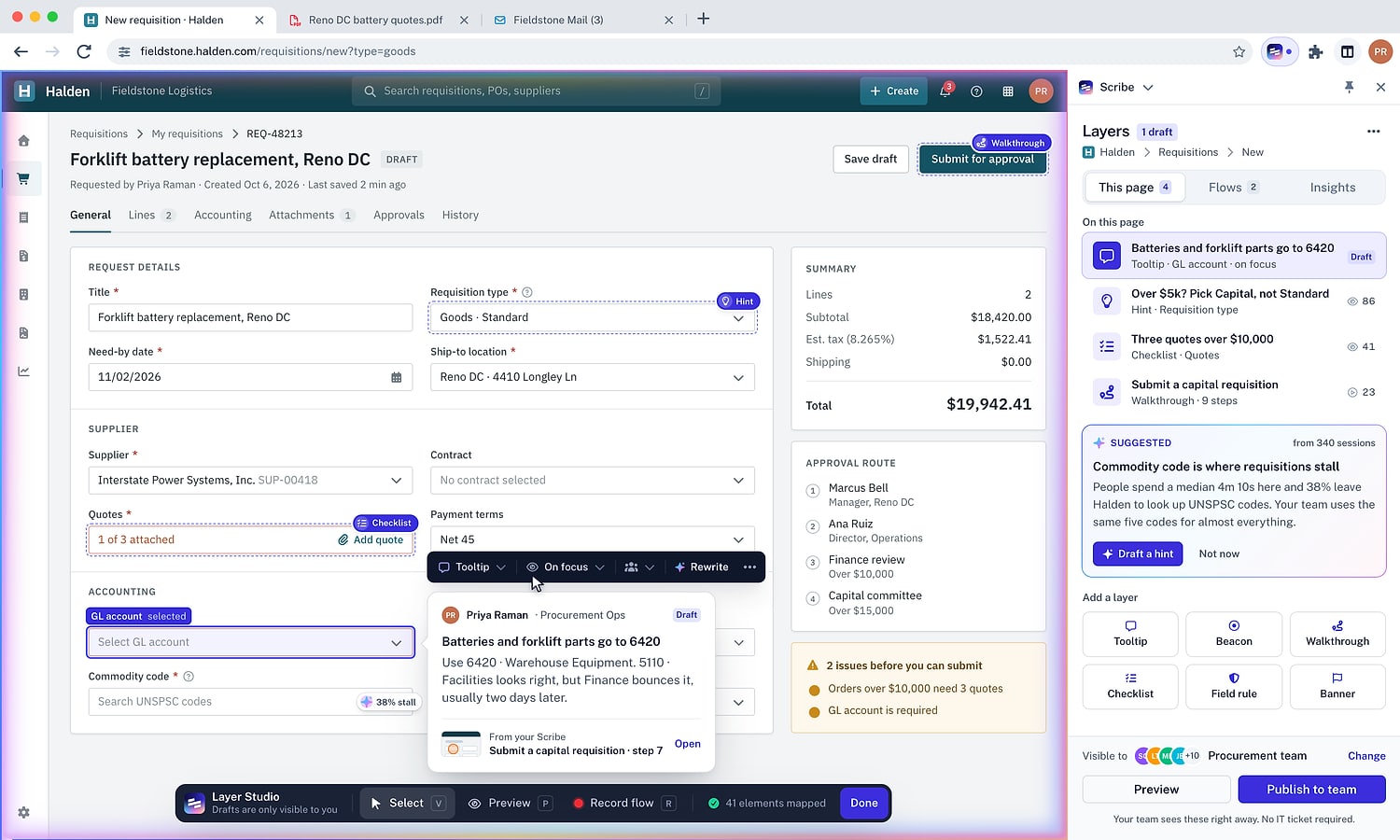
Studio mode turns Halden into a canvas only the author can see. Pick a field and Scribe drafts the layer from the matching step of the Scribe, in Priya's own words. Priya edits it and publishes it to the team. No IT ticket.
Try it. Pick a field on the form. Scribe drafts its layer from the step Priya recorded there.
Six kinds of layer. Tooltip, hint, walkthrough, checklist, field rule and banner. In the pilot, tooltips and hints were most of what people published.
Studio mode can't be mistaken. A thin aurora glow around the page says you're editing. A 5px border read like an error, so it came down to a 1.5px line with the glow inside 12px.
Drafts in the author's voice. Scribe drafts from the step and the note typed while recording, in under two seconds a paragraph, and keeps the author's phrasing.
The team first. A new layer reaches the author's own team at once. Anyone further out takes a sign-off.
09 · Friction radar
Show the author where to write next
Go-to people know the questions they get. They can't see the people who gave up without asking. Friction radar lays the last 30 days of sessions over the page, so Priya can see where requisitions stall and draft a layer from there.
Heat on the fields. Commodity code burns hottest: 38% of people leave Halden there to look up a code, for a median of 4m 10s. 22% of requisitions are sent back for the wrong GL account.
Where requisitions drop off. Of 340 opened in 30 days, 129 were approved the first time. The two biggest drops sit at Accounting and first approval, which is where the GL questions live.
Ranked by time stalled. Each hotspot comes with a suggested layer, and Draft writes it from the team's Scribes. The first suggestion is a hint with the five commodity codes the team actually uses.
41
hours this page cost the team last month Time stalled across 340 sessions, the number that gets an author to open Studio.
10 · First contact
Three weeks in, Jordan gets the answer before asking
Jordan, an accounts payable specialist, installed the Scribe extension on day one because Priya's onboarding Scribe said to. Nobody turned anything on after that. The layers were just there, on the fields where Jordan would have messaged Priya.
Notes inside Halden's own menu. Layers can reach into the app's native controls. 6420 carries Priya's recommendation, and 5110 carries the warning Finance would have sent two days later.
Guide me. Priya's walkthrough runs on the real form, one step at a time. Lookups Scribe can do on its own, it offers to fill.
Ask from anywhere. ⌘K in Halden answers from the team's own Scribes and cites them. Priya answered 14 questions like this in September. Scribe answered the last 9.
Jordan's side · select a screen to view it full size
11 · Self-healing
Tours break when the app under them changes. The IT owners told us that's when platforms get switched off.
Halden 24.3
On Oct 14, Halden ships a redesign. Every field on the requisition page moves, and GL account becomes Expense account.
Matching
Scribe re-anchors each layer, matching it to its field again. Labels settle most of them, and a walkthrough also knows its step order, so it can find a button that moved.
Asking
Below 90% sure, it asks instead of guessing. Across the six Halden pages with layers, 14 of 15 re-anchored on their own. The renamed field asked Priya.
12 · Impact
Priya sees the hours given back
Go-to people do this work on top of their job, and nobody counts it. The impact page counts it for them, with a button to share it with their manager. In the interviews, recognition came up more often than time did.
31
hours given back in September
412
views of Priya's layers
57
questions Priya didn't have to answer
23
walkthrough runs
13 · Tipping point
IT finds 212 people depending on something nobody bought
How it spread
Jun 3: Priya's first layer goes up in Halden. 15 people in Procurement see it that month.
July
Accounts Payable and Finance find it next, through the requisitions they approve. 48 people.
August
The two distribution centers, Reno and Sparks, pick it up. 122 people.
September
212 people on 9 teams, and 0 tickets filed with IT. Dana Cho, who runs IT's app list, finds out from a usage report.
Governance
The best team layers get promoted to everyone
Fieldstone bought Scribe Enterprise on Oct 20. Dana's job changed from finding Layers to running it. A team layer that should reach the whole company now goes through review, and the owner of the field signs off.
14 people become 1,140. Priya asks to promote the GL tooltip from Procurement to every Halden user. For 928 of the 1,140 it would be the first layer they have ever seen, which is what the sign-off is for.
Two tooltips on one field. Finance already had one on GL account. Scribe drafts a merged version, and both authors keep credit.
A rule IT can live with. At Fieldstone, a layer shown to more than 200 people needs sign-off from the field's owner and from IT.
One button, and the right names under it. Ana Ruiz owns GL account for Finance and approves first. Dana publishes to 1,140 people, and Procurement can pull it back from History at any time.
All eleven screens · select one to view it full size
14 · Design language
Three colors, one job each
Layers lives on top of software Scribe doesn't own, so anything it adds has to read as Scribe's at a glance. I built it in Stylus, Scribe's design system, and gave each color a single meaning.
Orange means click here. The ring on a click target, and nothing else. Warnings and badges never borrow it.
Indigo means Scribe added this. Pins, hints and tooltips are indigo. Halden, the host app in the story, never uses indigo or orange.
The aurora means AI is working. Scribe's aurora shows while something is being drafted or answered, and never as decoration.
Springs for anything that lands on an element. Stiffness 500, damping 40, so a layer snaps onto its field. Drag the pin away and let go.
Stylus first. Where Stylus had no component, I built it from shadcn's open-source components and restyled it with Stylus recipes, down to the 32px buttons and slate-tinted shadows.
15 · Decisions
Five calls, written up as a Scribe
Each one is a step, the way Scribe writes them, with what it cost underneath. Product, engineering and security each pushed back on at least one.
The calls behind Layers5 steps · Jake Ledford
Start from the capture people already make
Go-to people already record Scribes. A blank builder would have been one more tool to learn before the first layer existed.
Cost A messy recording makes a messy walkthrough, so capture got a cleanup pass before anything goes live.
Publish to your own team without IT
Bottom-up only works if the first layer needs nobody's permission.
Cost Security wanted the opposite. We met at a cap: past 200 people, a layer needs the field's owner and IT to sign off.
Move a layer on its own only when 90% sure
A wrong tooltip does more harm than a missing one. People stop reading layers once one of them has been wrong.
Cost Authors get a review request after big releases. In testing, about 1 layer in 15.
Keep orange for clicks
In a walkthrough the ring has to be the only orange thing on the screen, or people click the wrong thing.
Cost Scribe's orange warnings had to change inside Layers. They went amber.
Answer only from the team's own sources
Ask cites a Scribe or a file for every claim, or it hands the question to the person who knows.
Cost Fewer answers. In the pilot, Ask passed about 1 question in 4 to a person.
16 · Outcomes
Fewer repeat questions, and buyers who came to us
58%
fewer repeat questions to go-to people The median across the six pilot companies, week one against week six.
93%
of layers re-anchored on their own Across 23 releases of the apps they sat on during the pilot. The rest asked their author.
3m 40s
median time to a first published layer Starting from a Scribe the author had already recorded, in moderated tests with 12 go-to people.
4 of 6
pilot companies asked about buying Before the pilot ended. Every one of those calls was started by a team lead.
“Nobody on my team asks me about GL codes anymore. They ask me the hard stuff, which is the actual job.”
In their words. From the pilot's closing interviews, week six.
The ground it stood on. Layers starts from Scribe's capture. The onboarding and capture rework I led across web, Windows and Mac lifted successful task completion by about 25%, and research-backed changes after it lifted user satisfaction by about 30%.
17 · Reflection
What I would do differently
- The diary changed the product more than the interviews did. In interviews people called their questions occasional, and the log showed the same twenty all week. Next time it runs in week one.
- Self-healing belonged in the first prototype. IT owners judged the whole idea on what happens after an update, and the first version we showed them was fragile.
- I'd design IT's side sooner. The bottom-up story only closes if the admin view is ready the day IT notices, and ours trailed the spread by a few weeks.
Next case study · Folia (Innovatemap)