01 · Overview
A client relocates an engineer to Manhattan for four months. A housing specialist builds the quote, and that quote depends on availability, cost, stay length and which building fits.
- Role
- Lead Product Designer
- Timeline
- Feb – Jul 2025
- Product
- FQ Live, internal sales platform
- Also
- Design system and governance
- Users
- Housing specialists, quoting live requests
- Team
- 1 product manager, 4 engineers, the sales operations lead
02 · The short version
Problem. A workflow spread across several tabs and hand-copied numbers.
What I did. Shadowed housing specialists on live requests and mapped the path from inbound email to sent quote. Then designed the rebuild around what that path showed.
What shipped. Inventory, pricing and property details feed one quote in progress.
Token setComponent libraryGovernance docsQuote builderInventory search
03 · Context
Availability lived in one system and pricing in another. Property details were somewhere else again.
One quote
Building one quote meant several open tabs and numbers copied by hand. Often it also took a message to a colleague asking whether a unit was still open.
Meanwhile
Requests from large accounts came in faster than the team could answer them.
04 · Research
Sit beside the quote while it happens
I sat with housing specialists while they quoted live requests and mapped the path from inbound email to sent quote. Along the way I counted every moment someone had to leave the tool.
Every dip is an exit. The upper line is the tool. Each time the path drops below it, the specialist went somewhere else to find out something the tool already knew.
9
Exits per quote. The median across the quotes I shadowed. The fewest was five, on a repeat booking.
Two weeks sitting beside six housing specialists, across 27 live requests. Every exit was logged with where they went and why.
05 · Finding
Very little of the time in a quote went to deciding anything.
Most of it went to retrieving information the tool already had.
So the rebuild kept the deciding and moved the retrieving into the tool.
DecidingRetrievingWaiting on a colleague
06 · Quote builder
The quote fills in while you browse
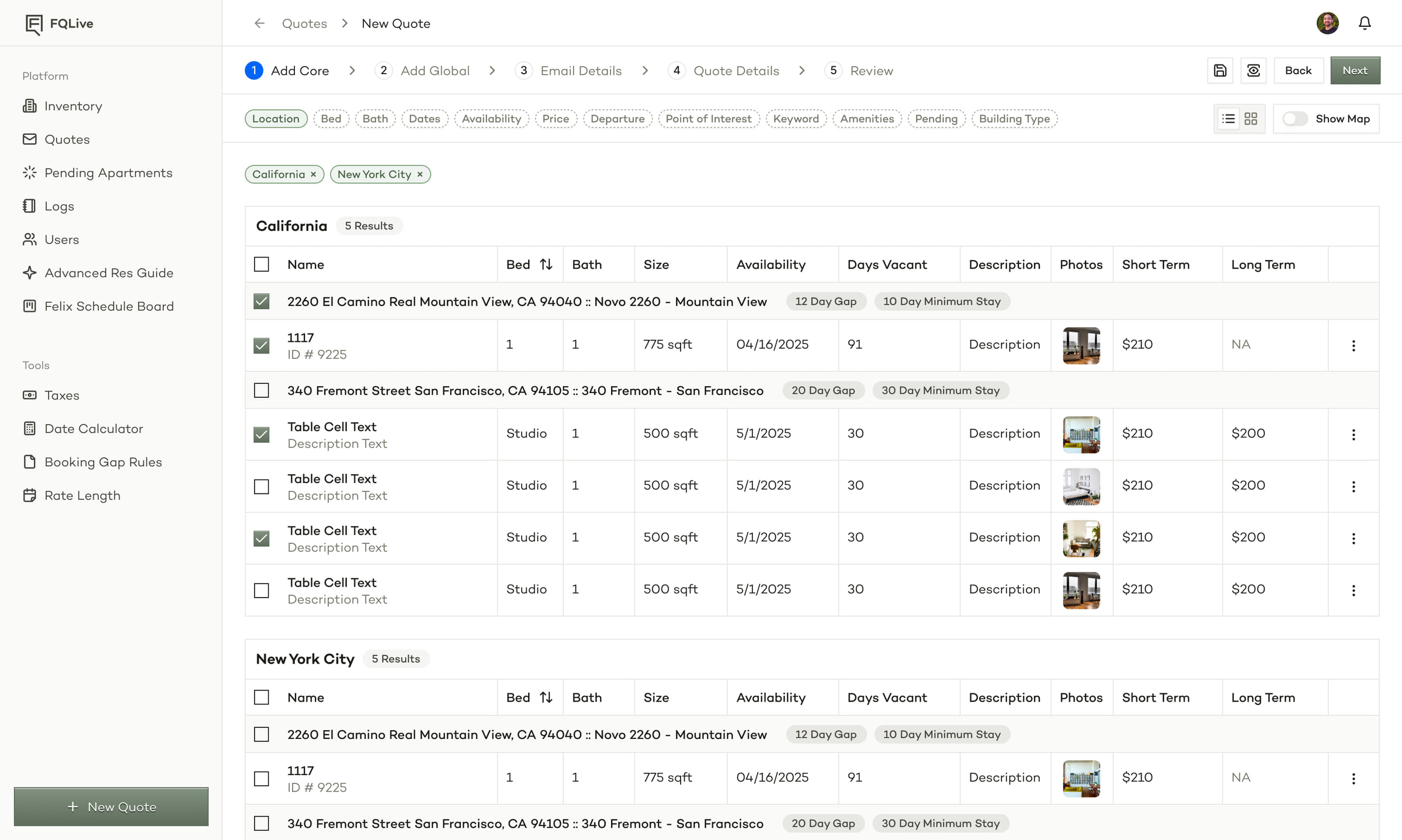
Inventory search and property listings feed a quote in progress, so a unit is added while browsing. New Quote runs in five steps. Units go in first, from inventory or from outside it, and the last step shows the email exactly as the client will get it.
Search starts with a place. Inventory groups results by city, beside a map. Each building's booking gap and minimum stay sit on its row, so they're known before a unit goes into a quote.
Step 2 of 5 · Add globalUnits from anywhere. Add core takes units from FQ's own inventory. Add global takes a unit from outside it, typed in with the same fields, so it sits in the quote like any other.
Step 3 of 5 · Email detailsStraight into the email. The units chosen while browsing arrive in the client email already filled in, in the order the specialist wants to present them.
Step 5 of 5 · ReviewWhat the client opens. The last step previews the quote as the client will see it, on FQ.com or in the email. The specialist checks it once, then sends.
07 · Property records
Built to be read aloud
Property records hold what a specialist reads aloud on a call: photos, layout, amenities, pet policy.
- Client
Can you send me photos of the bedroom?
Photos - Client
How is it laid out? Is there a desk?
Layout - Client
Is there a gym in the building?
Amenities - Client
He's bringing his dog. Is that a problem?
Pet policy
The call. Four questions from one relocation call, in the order the client asked them.
1117Tribeca · 1 bed · 1 bath
Photos


Layout
1 bedroom, 1 bath, 775 sq ft. Desk by the bedroom window.
Amenities
Fitness center24-hour conciergeIndoor poolCourtyard garden
Pet policy
Dogs and cats welcome, under 50 lb. One-time pet fee.
The record. Each answer sits where the specialist's eye already is, in roughly the order it gets asked.
08 · Pricing
Answered before the call ends
Pricing recalculates as stay length and unit mix change, so “what if we extend to six months?” gets answered during the call.
- SpecialistFour months from April 16th, one bedroom in Tribeca.
- ClientWhat if we extend to six months?
- ClientAnd a studio for his manager, same dates?
- SpecialistSending both now, before we hang up.
Unit mix
1 bed1
Studio1
2 bed0
- 1 bed · 1117 Tribeca
- Studio · 0903 Chelsea
- 2 bed · 2210 Tribeca
- NYC taxes
Total$0
Per night, all in$0
Long-term rateSent during the call
Try it: drag the stay length, or change the unit mix.
Tax, by market and stay. Every tax is stored with its market and the shortest and longest stay it applies to, so a long stay stops paying the ones it has outrun. Nobody looks it up mid-call.
Gaps worth filling. Pick a building and the calculator lists every gap between its bookings. The ones open right now are highlighted.
09 · Design system
Decided once, by name
Years of inconsistent patterns meant every new screen made fresh decisions about spacing, type and states. I built the token set and component library with engineering, then wrote the usage and governance docs and handed them to the internal team.
-
Layer 1Token set. Spacing, type and color decided once, by name, so a new screen inherits them instead of choosing again.
-
Layer 2Component library. Built with engineering, in the code the product ships, so the library and the product are the same thing.
-
Layer 3Governance docs. When to use each piece, and how to ask for a new one, handed to the internal team.
Every screen · select one to view it full size
10 · Decisions
Every call had a price
Three trade-offs shaped the rebuild. Each sat between two things worth wanting, and someone paid for every one of them.
Decision A
Live totals, with every override on the record
Answer on the callCheck before sending
Because
Clients made up their minds while they were still on the phone. A quote that waited for a second check often arrived after they had called someone else.
It cost
Finance gave up approving every quote before it went out. A manual price change now needs a reason, and those reasons are reviewed every week.
Decision B
Records ordered for the call
Everything we storeWhat gets said
Because
Specialists read a record from the top while the client listens. Photos, layout, amenities and pet policy came up on almost every call. Mail and key instructions came up after booking.
It cost
Operations notes moved down the page, below what gets said on the call, and the operations team rewrote building notes so they could be read aloud.
Decision C
A small, governed library over an open one
Anyone can addEvery addition reviewed
Because
The audit turned up near-copies of the same few components, and almost nothing that was actually missing. An open library would have grown the same way.
It cost
New patterns wait for review. One team waited a sprint for a date-range picker and shipped a workaround, which we later folded back in.
11 · Outcomes
What shipped, and what it changed
-
A rebuilt FQ Live: inventory, pricing and property details feed one quote in progress.
-
Pricing that recalculates while the specialist is still on the call.
-
A design system from token definitions through production, with governance docs handed to the team.
66%
less time from inbound email to sent quote Median of shadowed quotes: 38 minutes before the rebuild, 13 after. Same specialists, same kinds of request.
84%
of what-if questions answered before the call ended From call notes in the first eight weeks after launch. Before, most what-ifs became a follow-up email.
1
place to build a quote, where there had been several open tabs The rate sheet and the availability export were retired in the second month.
Before
38 min
After
13 min
The same quote, twice. The deciding stayed the same length. The retrieving is what left.
“I can price the what-if while they're still asking it.”
In their words. From a check-in with the sales team six weeks after launch.
12 · Reflection
What I would do differently
- I timed the old quote from shadowing notes, after the fact. It holds up, but it is thin. Next time the timer starts before the first sketch.
- I shadowed the people answering requests, not the large accounts sending them. Half the back-and-forth began in the request itself.
- Shipping the design system inside the quote builder meant every token was tested by a real screen from the first week. I would do that again.
Next case study · Scribe