


Allied Solutions

A discovery research initiative mapping the end-to-end client experience across the ARM repossession lifecycle, and surfacing the highest-impact opportunities for CenterPoint's next development cycle.
Senior UX Researcher & Designer
~11 Weeks
Interviews, Journey Mapping,
Design, Usability Testing


CLIENT VOICE
"It would be nice to see all of the actions and all of the correspondence in one place... a page that we would go to and then once it's been resolved, be able to move it out of that pipeline."
— Sr. Repo Specialist · PenFed Credit Union
1
CONTEXT
Lenders couldn't see what was happening to their assets
Allied Solutions manages asset recovery: repossession, remarketing, and claims — on behalf of credit unions and banks. Their CenterPoint portal was the client's window into that work, but lenders were operating blind.Status updates arrived by email. Auction outcomes required phone calls. Title delays had no explanation. My task was to understand exactly where visibility broke down and map the entire client journey.

The Core Problem
CenterPoint existed but lenders had developed parallel shadow systems — Outlook folders, Excel trackers, and phone trees — to manage work the product should have been doing.

11 Week
Discovery Sprint
5+
Credit Unions
Interviewed
2
DISCOVERY RESEARCH
What I found
Moderated interviews and workflow walkthroughs with repo specialists, managers, and client leads. Sessions followed a demo-first, discussion-second format to observe natural task flows before probing.
01
Workflow Fragmentation
Clients managed repossession entirely through Outlook folders and subfolders. No centralized view existed for active cases, holds, or pending actions.


02
Blind Spots
Zero in-app visibility into auction scheduling, sale outcomes, or title processing delays. Every update required a manual call or email to Allied staff.

03
Manual Reporting
Every client maintained parallel Excel trackers to reconcile CenterPoint data with internal records. Some ran daily exports just to stay current.

3
JOURNEY MAPPING
The client experience, phase by phase
Mapping the lender journey revealed consistent pain at every handoff; from repo order through to proceeds recovery. Each phase introduced a new visibility gap.
ORDER PLACED
Lender submits via RDN or AutoIMS

Case created in Pega ARM
Vendor assignment begins
Pain Point
No actionable confirmation returned to lender
ACTIVE REPO
Vendor attempts asset pickup
Updates flow only through RDN
Lender calls Allied to check status
Pain Point
No visibility into vendor activity or location
POST-REPO
Notice of intent to sell is sent to borrower
Redemption window tracked by email
Title request submitted externally
Pain Point
Title delays unexplained; multiple platforms checked
REMARKETING
Asset sent to auction or private sale
Sale communicated by phone
Proceeds calculated manually
Pain Point
Auction results invisible. Car can be sitting for months.
CLAIMS & CLOSE
Claim filed; status tracked
Proceeds reconciled internally
Case manually closed out
Pain Point
Inconsistent data across platforms. Hard to send out reports.
4
KEY INSIGHTS
What the research revealed


Email is the de-facto case management system
Lenders created Outlook folder hierarchies to track active cases, holds, NOI statuses, and document requests; work CenterPoint should be doing. The inbox had become the product.

Clients want self-serve, not support tickets
Every client preferred in-app access to auction results, title statuses, and claim history. Depending on Allied staff for basic status updates was a trust and efficiency issue, as speed and accuracy were top priority.



Notification preferences
are shifting
Clients want to move from email-based updates to in-app notifications with optional email digests; particularly for high-priority events like redemptions and auction outcomes.
5
DELIVERABLES
What came out of it
Research outputs fed directly into CenterPoint's design backlog and aligned with Pega ARM's development schedule.




End-to-End Journey Map
5-phase lender journey mapping touchpoints, tools, pain points, and emotional state across the full ARM lifecycle.




Client Personas
4 personas (Repo Specialist, Sr. Manager, Claims Lead, Portfolio Manager) grounded in interview data.


What’s the current status of the titling?

Has the Notice of Intent date been sent out?
Current-State Workflow Documentation
Analysis of how lenders use email, Excel, RDN, and AutoIMS together to manage recovery today.
Design Mockups
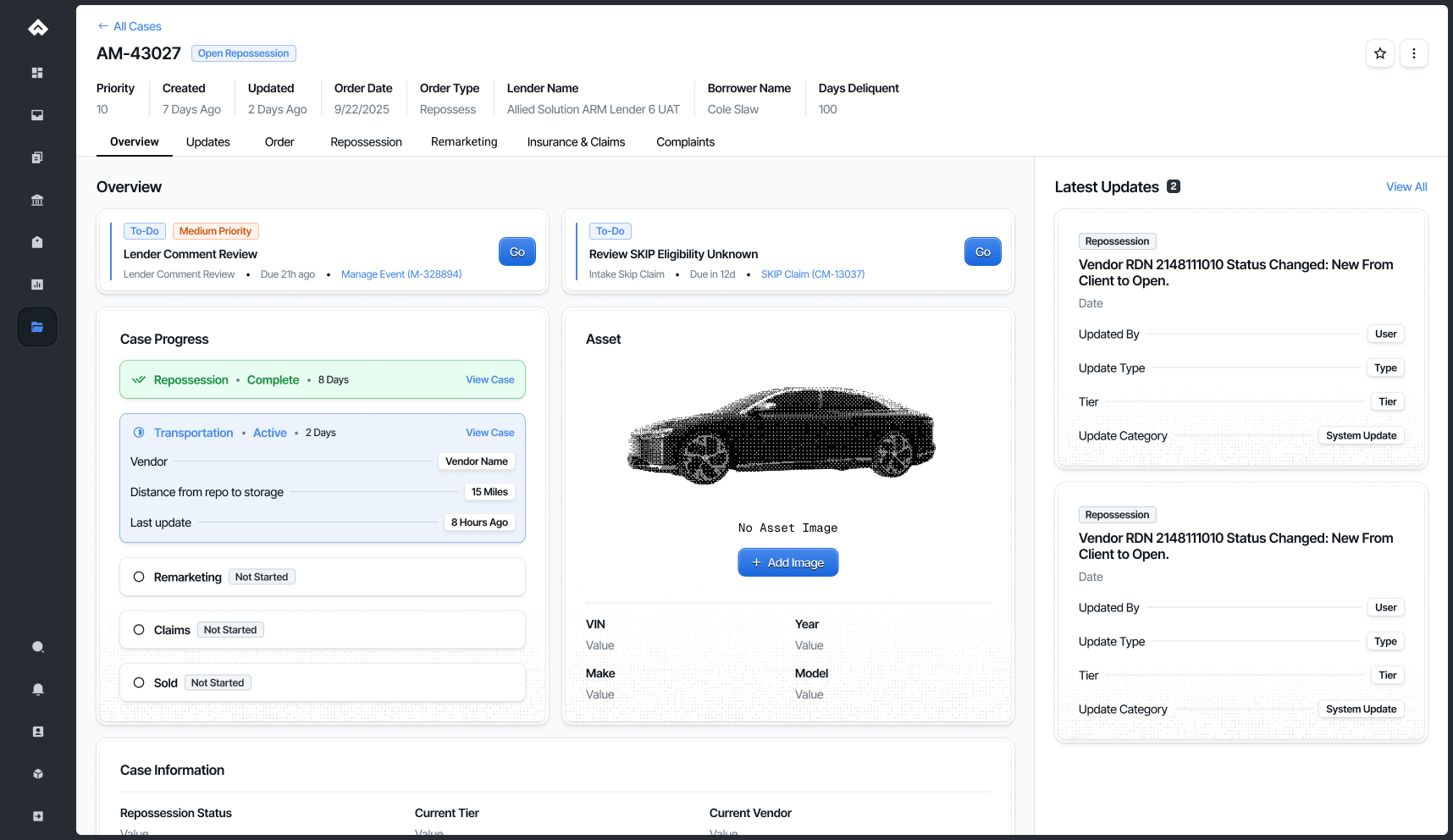
Centralized dashboard concept with real-time case visibility, auction status, title tracking, and in-app notifications.

Reporting








Research Report
Cross-client synthesis with prioritized opportunity areas, risk flags, and recommendations for product.




Usability Test Protocol
Maze-based unmoderated test targeting 80% task completion; metrics: SUS, SEQ, task time, misclick rate.
6
OUTCOMES
Impact & forward direction
Research directly shaped CenterPoint's design roadmap and created alignment across UX, product, and engineering on what to build first.
5
Credit union clients interviewed across discovery
3
Cross-client themes validated with full consistency
80%
Target task completion rate set for usability validation
1st
Structured UX research program established for ARM

© Jake Ledford 2026

Allied Solutions

A discovery research initiative mapping the end-to-end client experience across the ARM repossession lifecycle, and surfacing the highest-impact opportunities for CenterPoint's next development cycle.
Senior UX Researcher & Designer
~11 Weeks
Interviews, Journey Mapping, Design, Usability Testing


CLIENT VOICE
"It would be nice to see all of the actions and all of the correspondence in one place... a page that we would go to and then once it's been resolved, be able to move it out of that pipeline."
— Sr. Repo Specialist · PenFed Credit Union
1
CONTEXT
Lenders couldn't see what was happening to their assets
Allied Solutions manages asset recovery: repossession, remarketing, and claims — on behalf of credit unions and banks. Their CenterPoint portal was the client's window into that work, but lenders were operating blind.Status updates arrived by email. Auction outcomes required phone calls. Title delays had no explanation. My task was to understand exactly where visibility broke down and map the entire client journey.
The Core Problem
CenterPoint existed but lenders had developed parallel shadow systems — Outlook folders, Excel trackers, and phone trees — to manage work the product should have been doing.
11 Week
Discovery Sprint
M
t
w
t
f
s
s
1
2
3
4
5
6
7
8
9
10
11
12
13
14
15
16
17
18
19
20
21
22
23
24
25
26
27
28
5+
Credit Unions
Interviewed


2
DISCOVERY RESEARCH
What I found
Moderated interviews and workflow walkthroughs with repo specialists, managers, and client leads. Sessions followed a demo-first, discussion-second format to observe natural task flows before probing.
01
Workflow Fragmentation
Clients managed repossession entirely through Outlook folders and subfolders. No centralized view existed for active cases, holds, or pending actions.
02
Blind Spots
Zero in-app visibility into auction scheduling, sale outcomes, or title processing delays. Every update required a manual call or email to Allied staff.
03
Manual Reporting
Every client maintained parallel Excel trackers to reconcile CenterPoint data with internal records. Some ran daily exports just to stay current.
3
JOURNEY MAPPING
The client experience, phase by phase
Mapping the lender journey revealed consistent pain at every handoff; from repo order through to proceeds recovery. Each phase introduced a new visibility gap.
ORDER PLACED
Lender submits via RDN or AutoIMS

Case created in Pega ARM
Vendor assignment begins
Pain Point
No actionable confirmation returned to lender
ACTIVE REPO
Vendor attempts asset pickup
Updates flow only through RDN
Lender calls Allied to check status
Pain Point
No visibility into vendor activity or location
POST-REPO
Notice of intent to sell is sent to borrower
Redemption window tracked by email
Title request submitted externally
Pain Point
Title delays unexplained; multiple platforms checked
REMARKETING
Asset sent to auction or private sale

Sale communicated by phone
Proceeds calculated manually
Pain Point
Auction results invisible. Car can be sitting for months.
CLAIMS & CLOSE
Claim filed; status tracked
Proceeds reconciled internally
Case manually closed out
Pain Point
Inconsistent data across platforms. Hard to send out reports.
4
KEY INSIGHTS
What the research revealed
Email is the de-facto case management system
Lenders created Outlook folder hierarchies to track active cases, holds, NOI statuses, and document requests; work CenterPoint should be doing. The inbox had become the product.

Clients want self-serve, not support tickets
Every client preferred in-app access to auction results, title statuses, and claim history. Depending on Allied staff for basic status updates was a trust and efficiency issue, as speed and accuracy were top priority.
Notification preferences
are shifting
Clients want to move from email-based updates to in-app notifications with optional email digests; particularly for high-priority events like redemptions and auction outcomes.
5
DELIVERABLES
What came out of it
Research outputs fed directly into CenterPoint's design backlog and aligned with Pega ARM's development schedule.






End-to-End Journey Map
5-phase lender journey mapping touchpoints, tools, pain points, and emotional state across the full ARM lifecycle.
Client Personas
4 personas (Repo Specialist, Sr. Manager, Claims Lead, Portfolio Manager) grounded in interview data.

What’s the current status of the titling?
Has the Notice of Intent date been sent out?

Does this asset need to be filed as a SKIP claim?
Current-State Workflow Documentation
Analysis of how lenders use email, Excel, RDN, and AutoIMS together to manage recovery today.

Design Mockups
Centralized dashboard concept with real-time case visibility, auction status, title tracking, and in-app notifications.
Reporting
Research Report
Cross-client synthesis with prioritized opportunity areas, risk flags, and recommendations for product.
Usability Test Protocol
Maze-based unmoderated test targeting 80% task completion; metrics: SUS, SEQ, task time, misclick rate.
6
OUTCOMES
Impact & forward direction
Research directly shaped CenterPoint's design roadmap and created alignment across UX, product, and engineering on what to build first.
5
Credit union clients interviewed across discovery
3
Cross-client themes validated with full consistency
80%
Target task completion rate set for usability validation
1st
Structured UX research program established for ARM


Indianapolis, IN, USA
© Jake Ledford 2026

Allied Solutions
A discovery research initiative mapping the end-to-end client experience across the ARM repossession lifecycle, and surfacing the highest-impact opportunities for CenterPoint's next development cycle.
Senior UX Researcher & Designer
~11 Weeks
Interviews, Journey Mapping, Design, Usability Testing

CLIENT VOICE
"It would be nice to see all of the actions and all of the correspondence in one place... a page that we would go to and then once it's been resolved, be able to move it out of that pipeline."
— Sr. Repo Specialist · PenFed Credit Union
1
CONTEXT
Lenders couldn't see what was happening to their assets
Allied Solutions manages asset recovery: repossession, remarketing, and claims — on behalf of credit unions and banks. Their CenterPoint portal was the client's window into that work, but lenders were operating blind.Status updates arrived by email. Auction outcomes required phone calls. Title delays had no explanation. My task was to understand exactly where visibility broke down and map the entire client journey.
The Core Problem
CenterPoint existed but lenders had developed parallel shadow systems — Outlook folders, Excel trackers, and phone trees — to manage work the product should have been doing.

11 Week
Discovery Sprint
M
t
w
t
f
s
s
1
2
3
4
5
6
7
8
9
10
11
12
13
14
15
16
17
18
19
20
21
22
23
24
25
26
27
28
5+
Credit Unions
Interviewed
2
DISCOVERY RESEARCH
What I found
Moderated interviews and workflow walkthroughs with repo specialists, managers, and client leads. Sessions followed a demo-first, discussion-second format to observe natural task flows before probing.
01
Workflow Fragmentation
Clients managed repossession entirely through Outlook folders and subfolders. No centralized view existed for active cases, holds, or pending actions.
02
Blind Spots
Zero in-app visibility into auction scheduling, sale outcomes, or title processing delays. Every update required a manual call or email to Allied staff.

03
Manual Reporting
Every client maintained parallel Excel trackers to reconcile CenterPoint data with internal records. Some ran daily exports just to stay current.
3
JOURNEY MAPPING
The client experience, phase by phase
Mapping the lender journey revealed consistent pain at every handoff; from repo order through to proceeds recovery. Each phase introduced a new visibility gap.
ORDER PLACED
Lender submits via RDN or AutoIMS

Case created in Pega ARM
Vendor assignment begins
Pain Point
No actionable confirmation returned to lender
ACTIVE REPO
Vendor attempts asset pickup
Updates flow only through RDN
Lender calls Allied to check status
Pain Point
No visibility into vendor activity or location
POST-REPO
Notice of intent to sell is sent to borrower
Redemption window tracked by email
Title request submitted externally
Pain Point
Title delays unexplained; multiple platforms checked
REMARKETING
Asset sent to auction or private sale

Sale communicated by phone
Proceeds calculated manually
Pain Point
Auction results invisible. Car can be sitting for months.
CLAIMS & CLOSE
Claim filed; status tracked
Proceeds reconciled internally
Case manually closed out
Pain Point
Inconsistent data across platforms. Hard to send out reports.
4
KEY INSIGHTS
What the research revealed
Email is the de-facto case management system
Lenders created Outlook folder hierarchies to track active cases, holds, NOI statuses, and document requests; work CenterPoint should be doing. The inbox had become the product.
Clients want self-serve, not support tickets
Every client preferred in-app access to auction results, title statuses, and claim history. Depending on Allied staff for basic status updates was a trust and efficiency issue, as speed and accuracy were top priority.
Notification preferences
are shifting
Clients want to move from email-based updates to in-app notifications with optional email digests; particularly for high-priority events like redemptions and auction outcomes.
5
DELIVERABLES
What came out of it
Research outputs fed directly into CenterPoint's design backlog and aligned with Pega ARM's development schedule.



End-to-End Journey Map
5-phase lender journey mapping touchpoints, tools, pain points, and emotional state across the full ARM lifecycle.
Client Personas
4 personas (Repo Specialist, Sr. Manager, Claims Lead, Portfolio Manager) grounded in interview data.

What’s the current status of the titling?
Has the Notice of Intent date been sent out?
Does this asset need to be filed as a SKIP claim?
Current-State Workflow Documentation
Analysis of how lenders use email, Excel, RDN, and AutoIMS together to manage recovery today.
Design Mockups
Centralized dashboard concept with real-time case visibility, auction status, title tracking, and in-app notifications.
Reporting
Research Report
Cross-client synthesis with prioritized opportunity areas, risk flags, and recommendations for product.
Usability Test Protocol
Maze-based unmoderated test targeting 80% task completion; metrics: SUS, SEQ, task time, misclick rate.
6
OUTCOMES
Impact & forward direction
Research directly shaped CenterPoint's design roadmap and created alignment across UX, product, and engineering on what to build first.
5
Credit union clients interviewed across discovery
3
Cross-client themes validated with full consistency
80%
Target task completion rate set for usability validation
1st
Structured UX research program established for ARM

Indianapolis, IN, USA
© Jake Ledford 2026